
Sketching a tiger is a challenging yet rewarding task for any artist. With its distinctive orange and black stripes, powerful muscles, and majestic gaze, capturing the beauty of this wild animal requires attention to detail and a good understanding of proportions and anatomy. Even seasoned artists may struggle to get it right, which is why we’ll be breaking down the process into manageable steps. In this article, you’ll learn how to draw a realistic tiger with confidence, starting from the basics of proportions and building up to more advanced techniques such as texture and shading. By following these step-by-step instructions, you’ll improve your skills and be able to capture the essence of this majestic creature on paper, allowing you to appreciate its beauty and power in a whole new way.
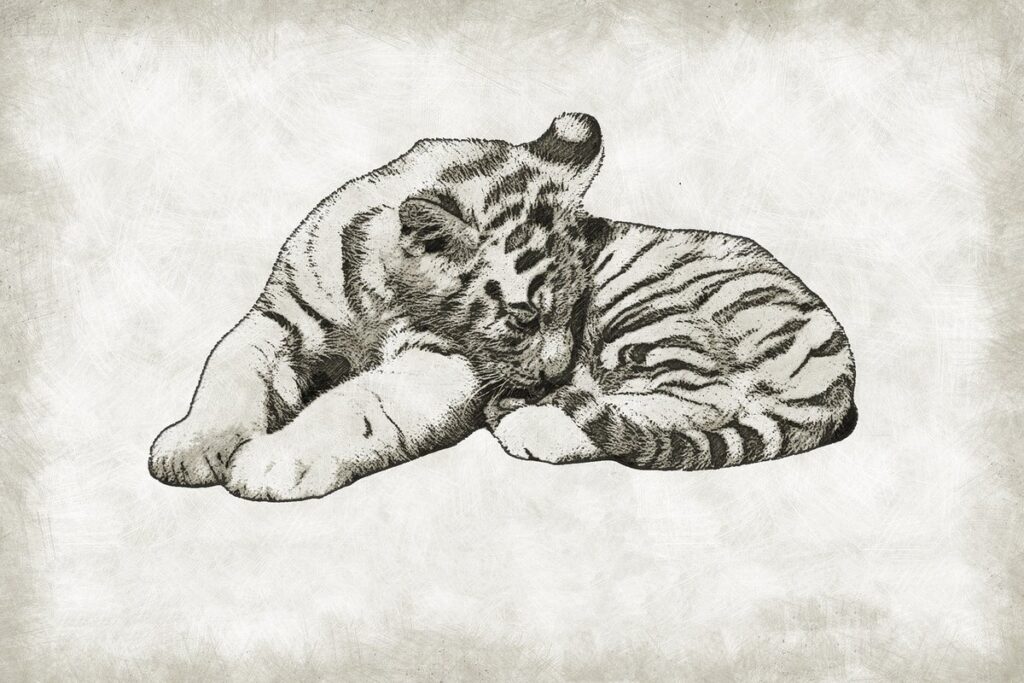
Understanding Your Subject
To sketch a tiger accurately, you first need to understand its anatomy and body proportions, including its powerful legs, sharp claws, and distinctive coat patterns. Let’s break down these key features together.
Familiarizing Yourself with Basic Proportions
When measuring a tiger’s proportions, it’s essential to start by understanding its overall body shape. Observe how a tiger’s torso is roughly three times as long as its head. Note the distance between the tip of the nose and the base of the neck, which should be around one-third of the total length from nose to tail. To apply this to your sketch, lightly draw a vertical line on your paper to represent the center of the body.
Next, divide the torso into thirds both horizontally and vertically. The front legs should be roughly positioned at the middle third mark, while the back legs are slightly closer to the rear third. This will help you achieve the correct balance between the animal’s forequarters and hindquarters. Measure the length of each leg against the corresponding body section to ensure proper proportion. Pay attention to the placement of the shoulder blades, which should align with the top quarter mark on either side of the vertical center line. By applying these simple measurements and markings, you’ll be able to accurately capture a tiger’s basic proportions in your sketch.
Analyzing Reference Images
When studying reference images for a tiger, it’s essential to note the subtleties of its anatomy. A tiger’s stripes, coloration, and body structure can vary greatly between individuals, making accurate representation crucial. Look for images that showcase a wide range of poses, angles, and lighting conditions to capture these nuances.
Reliable sources for reference images include wildlife photography websites, nature documentaries, and high-quality stock photo libraries. Websites like National Geographic or the World Wildlife Fund often feature stunning images of tigers in their natural habitats. When searching online, use specific keywords like “tiger anatomy” or “wild tiger behavior” to find relevant images.
To analyze reference images effectively, focus on the overall proportions, muscle structure, and movement lines. Pay attention to how the stripes interact with the surrounding environment and how the animal’s posture conveys a sense of power or agility. By studying these details, you’ll develop a more accurate understanding of your subject and be able to convey it in your sketch. Look for images that show tigers in different contexts – from resting to hunting – to get a comprehensive view of their behavior.
Penciling Stage
Now that you’ve got a rough outline, it’s time to add some details and texture to your tiger sketch. This is where pencil work comes in to bring out the fur patterns and define the overall shape.
Basic Shapes and Forms
When breaking down a tiger into basic shapes, start with simple forms to build a solid foundation for your sketch. The body of the tiger is typically an oval shape, but it’s essential to elongate it slightly, making it more teardrop-like. This will help capture the animal’s muscular build and agile posture. Position this oval so that its center aligns with the top of the head.
The head itself can be a circle or an ellipse, depending on your preference for a rounder or sharper facial structure. Place it above the center of the body, taking care to maintain a slight overlap between the two forms. The legs should be cylinders, tapering towards the paws. These cylindrical shapes will help you achieve the tiger’s powerful and agile stance.
Remember that these basic shapes should not be overly detailed at this stage – focus on proportions rather than details. A rough sketch of the body, head, and legs will allow you to evaluate the overall balance of your composition before moving forward with more defined features and textures.
Adding Musculature and Details
Start by adding some definition lines under the outline of the tiger’s body to help you gauge its proportions. Use gentle, even hatching strokes with a range of line weights to suggest the underlying musculature. You can achieve this by varying the pressure and angle of your pencil marks.
For more defined muscle shapes, switch to cross-hatching techniques. Hold your pencil at a 45-degree angle and use short, evenly spaced strokes that overlap slightly. This creates a series of intersecting lines that give depth and dimensionality to the drawing.
Fur textures can be added using a range of hatching and stippling techniques. For instance, longer, more expressive strokes can create the tiger’s distinctive whisker texture, while shorter, more even marks can suggest the smoothness of its belly fur.
When rendering fur patterns, focus on capturing the underlying structure of the individual hairs rather than trying to draw every single strand. Use loose, curved lines to block in the general direction and flow of the fur, then add more defined textures and details last.
Refining Your Drawing
Now that you’ve got a solid foundation for your tiger sketch, let’s fine-tune those lines and details to capture its majestic essence. This is where refinement really shines through in your artwork.
Smoothing Out Lines and Shapes
When drawing a tiger’s body, it’s easy to get caught up in capturing its muscular contours. However, without smoothing out rough lines and shapes, your sketch can end up looking stiff and unnatural. This is particularly true when transitioning from one shape to another – for example, from the tiger’s broad chest to its slender neck.
One technique to achieve smooth transitions is to use gentle curves. Instead of drawing sharp corners or jarring angles, try sketching the lines that connect these shapes with soft, flowing curves. For instance, as you move from the tiger’s ribcage to its shoulder blades, imagine a continuous arc rather than a series of distinct edges.
Another approach is to overlap and blend your lines. When transitioning between shapes, try drawing one line over another, feathering it out so that it merges with the underlying shape. This helps create a sense of fluidity and cohesion throughout the body. By using these techniques, you can transform rough sketches into more refined, natural-looking drawings.
Adding Facial Expressions and Eyes
When drawing a tiger’s face, remember that its facial expression should reflect its mood and personality. A calm tiger might have slightly relaxed features, while an agitated one could display a more tense, snarled appearance. To convey these emotions through the eyes, observe how humans express themselves – a raised eyebrow can indicate skepticism or surprise, for instance.
Tigers’ eyes are almond-shaped and slanted upwards at the outer corners. The pupil should be vertical, giving a piercing look. When drawing the eyes, consider the shape of the eyelids and eyelashes as well. Thick, feathery lashes add to the tiger’s wild appearance, while delicate lids create a softer, more vulnerable expression.
In a sketch, you can emphasize a tiger’s emotions by adjusting its eye placement within the head. A direct stare or an intensely focused gaze can convey confidence or aggression, whereas a slightly cast-aside glance might suggest fatigue or distraction. Experiment with different expressions and attitudes to capture the unique essence of your tiger subject.
Advanced Techniques
Now that you have a solid foundation, let’s dive into more complex techniques to capture the tiger’s majesty and power on paper. We’ll explore ways to create dramatic expressions and dynamic poses.
Rendering Fur Texture
When rendering fur texture on your tiger sketch, it’s essential to experiment with various hatching and cross-hatching patterns. A common technique is to use short, curved strokes for smooth areas like the belly or face, while longer, more angular strokes can create a rougher texture on the shoulders or back. Varying line weight and direction adds depth and dimension.
Try using diagonal hatching for areas with prominent muscles, such as the tiger’s neck or legs. This creates a sense of bulk and tension. For smoother fur, use softer, more rounded lines that blend into one another. Pay attention to the overall texture and adjust your strokes accordingly.
In the following areas, focus on creating subtle transitions between light and dark: along the spine, under the ribcage, and around the tail. These zones often exhibit a softening of texture due to muscle movement and bone structure. Experiment with different combinations of hatching and cross-hatching patterns to achieve realistic fur textures that capture the essence of your tiger sketch.
Capturing Movement and Action
When capturing a tiger’s movement, consider the lines of energy flowing through its body. Imagine arrows emanating from its muscles as it springs into action. To convey dynamic movement, emphasize the tension and release in the animal’s limbs and torso. For example, when depicting a running tiger, exaggerate the extension of its legs and tail, while softening the joints to suggest fluid motion.
To further enhance the sense of energy, consider capturing the blur created by rapid movement. Use loose, expressive brushstrokes or gestural lines to convey speed and agility. A hunting tiger’s stalking pose, on the other hand, requires a more contained energy. Focus on the taut muscles in its legs and back, as it coiled power is ready to unleash.
Note how these different actions are often accompanied by distinctive body language: a running tiger will have its ears laid back, while a stalking one will be perked up and alert. By studying real-life examples or observing tigers in captivity, you can develop a deeper understanding of the subtle cues that reveal an animal’s state of mind and activity level.
Tips for Success
Now that you have a basic tiger sketch under your belt, let’s move on to some expert tips to help you perfect your design and make it truly roar.
Overcoming Common Challenges
Proportion is often the first challenge artists face when sketching tigers. To get it right, study reference images and observe how a tiger’s body mass shifts from its powerful shoulders to its long, slender tail. A common mistake is to make the head too small or the legs too short – remember that a tiger’s torso accounts for roughly 60% of its overall length.
Capturing the fur texture can be equally tricky. To achieve the right look, experiment with different brush strokes and line weights. Varying between smooth, flowing lines and textured, scratchy ones will help convey the complex pattern of a tiger’s coat. Pay attention to how light interacts with the fur – soft shadows and highlights can greatly enhance the overall appearance.
When rendering the eyes and facial features, artists often struggle to capture the tiger’s fierce yet enigmatic expression. Study the shape and structure of the eye sockets, and remember that the nose is typically small and recessed. To convey intensity or calmness, pay attention to the subtle nuances in the eyelid and eyebrow folds – a raised brow can make all the difference in conveying the tiger’s mood.
Practice and Perseverance
Mastering the art of drawing tigers requires consistent practice and perseverance. It’s not something you can pick up overnight, but with regular effort, you’ll see significant improvement. Set aside a specific time each week to sketch, even if it’s just for 15-20 minutes. Experiment with different techniques, such as using reference images or observing the tiger in person.
Start by focusing on basic shapes and proportions, gradually moving on to more intricate details like stripes and textures. Practice drawing from life or from photographs, paying attention to the tiger’s anatomy and movement. Try sketching the tiger from multiple angles to develop your understanding of its form.
Don’t be discouraged if your early attempts don’t turn out as expected – it’s normal for beginners to struggle with proportions and perspective. The key is to keep practicing, even when you feel like giving up. As you become more comfortable, try experimenting with different mediums, such as pencils, charcoal, or ink.
Conclusion
Now that you’ve put your sketching skills to the test, let’s wrap up by reviewing what makes a great tiger sketch.
Recap of Key Takeaways
To effectively sketch a tiger, remember that proportion and anatomy are key. The tiger’s body is roughly twice as long as its head, with the front legs being slightly longer than the hind legs. Pay attention to the shape of the ears, which should be rounded at the tips and pointed at the base. The eyes should be relatively large and positioned about one-third down from the top of the head.
When it comes to lines and gestures, use smooth, flowing strokes to capture the tiger’s sleek fur texture. Focus on conveying energy and movement through dynamic line work. Avoid stiff or rigid lines, as they can make the drawing appear static. Instead, aim for a sense of tension and power.
In terms of overall composition, balance your subject by placing it in a harmonious environment that reflects its natural habitat. Consider using simple shapes to help guide your sketching process, especially when capturing the tiger’s muscular build. By keeping these key concepts in mind, you’ll be well on your way to creating a compelling and accurate representation of this majestic animal.
Final Thoughts and Encouragement
As you complete your tiger sketch and set it aside, remember that art is a journey, not a destination. It’s okay if your lines are wobbly, your proportions off, or your shading patchy – these imperfections are what make your piece unique and human. Don’t be afraid to experiment with new techniques, try bold brushstrokes, and push the boundaries of what you thought possible.
The key to mastering the tiger sketch is consistent practice. Set aside a specific time each week to hone your skills, and don’t worry if it feels tedious at first – this is where growth happens. Try breaking down your sketch into smaller components, focusing on individual features like eyes or stripes before moving on to more complex areas.
Remember why you started sketching in the first place: for fun, to express yourself, and to tap into your creative potential. Don’t get discouraged by setbacks or self-criticism – instead, use them as opportunities to learn and improve. With persistence, patience, and a willingness to take risks, you’ll be well on your way to creating stunning tiger sketches that leap off the page.
Frequently Asked Questions
Can I start with drawing the tiger’s face?
Yes, it’s perfectly fine to start with the facial features as they can be easier to draw and help you get into the right proportions. However, keep in mind that this might not give you a complete understanding of the entire body’s proportions.
How do I know when my tiger is proportionally correct?
To ensure your tiger’s proportions are accurate, refer back to reference images and measure your drawing against the guidelines discussed in the article. Pay attention to the body length, head size, and limb proportions to get it right.
Can I use digital tools to draw a tiger instead of traditional mediums?
While digital tools can be useful for sketching, traditional mediums like pencils and paper offer unique benefits for learning anatomy and proportion. However, if you prefer digital drawing, choose software that allows for precise control over lines and shapes.
How do I practice capturing movement and action in my drawings?
To capture dynamic movement and energy in your drawings, practice observing real-life animals or study reference images of tigers in motion. Experiment with different techniques such as gesture drawing or quick sketches to get a sense of movement and fluidity.