
Writing a sonnet can seem daunting, especially with its strict 14-line structure and traditional rhyme scheme. You may be wondering where to begin when crafting your own poem within this classic form. The sonnet has a rich history, dating back to Italy in the 13th century, and has been shaped by masters such as Shakespeare and Petrarch over the centuries. Despite its complexity, mastering the sonnet can help you develop skills that will serve you well in writing other forms of poetry. In this step-by-step guide, we’ll cover the basics of sonnet structure, provide tips on how to craft a compelling narrative within its traditional 14-line framework, and offer advice for navigating the challenges of writing a sonnet that resonates with readers by the time you finish this article.
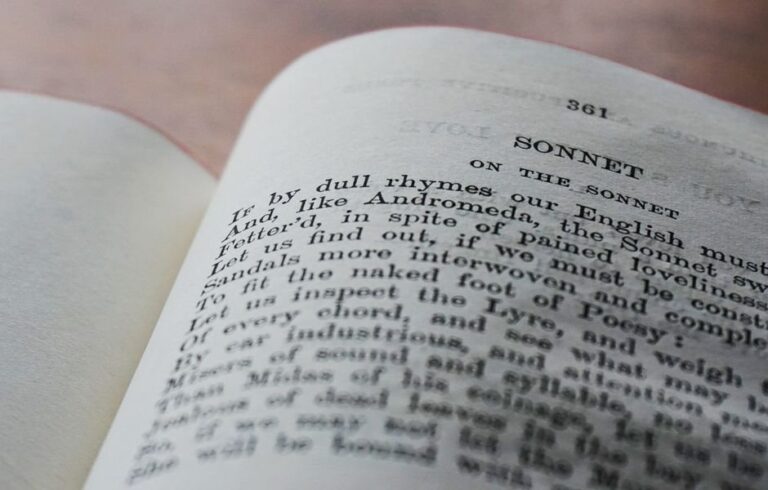
Understanding Sonnets and their History
Before we dive into crafting a perfect sonnet, let’s explore the rich history and structure of these 14-line poems that have been written by Shakespeare and other masters.
Origins of the Sonnet Form
In 13th-century Italy, the sonnet form began to take shape under the influence of troubadours and courtly love poetry. One of the key figures who contributed to its development was Petrarch, an Italian poet known for his lyrical and expressive style. His use of the Tuscan dialect and adherence to a specific rhyme scheme helped establish the foundations of the sonnet form.
As the centuries passed, other poets built upon Petrarch’s work, adapting and refining the sonnet structure to suit their own purposes. Shakespeare, in particular, is famous for his mastery of the English sonnet, using it to explore themes of love, beauty, and mortality. His sonnets are renowned not only for their technical skill but also for their emotional depth and resonance.
The influence of these early poets can still be seen today in the structure and conventions of traditional sonnets. Understanding the origins of this form is essential for any poet looking to craft a perfect sonnet. By studying the works of Petrarch, Shakespeare, and other key figures, you’ll gain valuable insight into how to shape your own sonnets and create a compelling narrative.
Note: A good rule of thumb when writing sonnets is to experiment with different forms and styles while paying homage to the traditional structure and conventions that have come before.
Key Characteristics of a Traditional Sonnet
A traditional sonnet is defined by its strict adherence to specific structural and thematic guidelines. The most well-known form of a traditional sonnet is the Shakespearean sonnet, consisting of 14 lines divided into four quatrains and a final couplet. This structure provides a clear framework for exploring complex emotions and ideas.
The rhyme scheme of a traditional sonnet follows a specific pattern: ABAB CDCD EFEF GG. The first quatrain introduces the theme or subject, while the second quatrain develops this idea further. The third quatrain often presents a turn or shift in perspective, leading to the resolution or conclusion in the final couplet.
Typically, traditional sonnets explore themes of love and beauty, but not exclusively so. Poets like Shakespeare and Petrarch used the sonnet form to examine mortality, time, and human experience. However, it’s essential for poets to understand that these themes are not rigidly defined; rather, they serve as starting points for creative exploration.
When crafting your own traditional sonnet, remember that adhering to its key characteristics is crucial. The strict structure allows for subtle nuance and skillful manipulation of language. By mastering the traditional sonnet form, you’ll develop a deeper understanding of poetic craft and be able to create works that convey complex emotions and ideas with precision.
Choosing Your Theme or Subject Matter
Your sonnet’s success hinges on a thoughtful and engaging theme, so let’s start by exploring how to choose a theme that resonates with your readers. This will help you craft a poem that’s both meaningful and memorable.
Identifying Inspiration
Drawing from personal experiences can be a rich source of inspiration for sonnets. Consider moments of joy, heartbreak, or profound realization that have stayed with you over time. Jot down key details and emotions associated with these events to help spark ideas. Nature, too, is a treasure trove of themes: observe the way sunlight filters through leaves, the songs of birds at dawn, or the intricate patterns on a butterfly’s wings.
Literary and artistic influences can also be potent inspirations. Read sonnets by masters like Shakespeare, Elizabeth Barrett Browning, or Pablo Neruda to see how they explored themes of love, mortality, and social commentary. Visit museums, galleries, or exhibitions to immerse yourself in various art movements and styles. Note the ways artists use symbolism, color palette, or composition to convey meaning.
When exploring literature and art, pay attention to specific elements that resonate with you: a character’s conflict, a poet’s use of metaphor, or an artist’s depiction of everyday life. Consider how these elements can be adapted or reinterpreted in your sonnet. Think about what themes are closest to your heart and how they might be explored through the lens of a traditional sonnet form.
Brainstorming and Outlining
When brainstorming ideas for your sonnet, it’s essential to consider the theme and subject matter you want to explore. Ask yourself: What sparks my creativity? Is it a personal experience, a historical event, or a philosophical concept? Jot down as many potential ideas as possible, without worrying about their feasibility at this stage.
Once you have a list of possibilities, start grouping related ideas together. This will help you identify patterns and connections that can inform your sonnet’s structure and meaning. For example, if you’re interested in exploring love, you might group ideas around romantic relationships, heartbreak, or the passage of time.
A basic outline should include the following key elements:
- A clear theme or subject matter
- A working title or concept
- A rough idea of the sonnet’s structure and rhyme scheme
- Key words or phrases that evoke the tone and mood you want to convey
Use a simple diagram or mind map to visualize your ideas, or try freewriting to get your thoughts down on paper. Remember, this is a preliminary stage – don’t worry too much about grammar or syntax at this point. The goal is to generate ideas and create a foundation for your sonnet’s development.
Mastering Sonnet Structure: Quatrain and Couplet
Now that you have a solid understanding of sonnet basics, let’s focus on building a strong foundation through mastering the quatrain and couplet, two essential elements in a traditional sonnet. These units are crucial for creating a cohesive and meaningful poem.
Understanding the Role of the Quatrain
In a traditional sonnet, the quatrain typically appears in the first or second position and serves as the foundation for the rest of the poem. A well-crafted quatrain sets up the theme, establishes the tone, and introduces key ideas that will be explored throughout the sonnet. Analyzing Shakespearean quatrains is particularly enlightening, as they often feature clever wordplay and nuanced exploration of themes.
One notable characteristic of Shakespeare’s quatrains is their use of subtle connections between lines. For instance, in Sonnet 18, the first quatrain reads: “Shall I compare thee to a summer’s day? / Thou art more lovely and more temperate…” The repetition of the word “thou” creates a sense of continuity between lines, while the contrast between the two ideas (comparing the beloved to a summer’s day vs. emphasizing their beauty) sets up the rest of the poem.
When crafting your own quatrain, consider using this approach to establish connections and create a cohesive narrative thread. Focus on developing key ideas and introducing relevant themes, all while maintaining a clear and concise structure.
Crafting Effective Couplet Endings
Crafting effective couplet endings is crucial to rounding out your sonnet and leaving a lasting impression on the reader. A well-crafted couplet can tie together loose ends, add final thoughts, or even introduce a new perspective. To achieve this, consider using one of three strategies: 1) Recap the central idea with fresh language; 2) Introduce a counterpoint to create tension; or 3) End on a note that invites further contemplation.
When recapitulating your central idea, avoid simply rephrasing what came before. Instead, use new words and phrasing to summarize key points in a concise manner. For example: “And thus our passions’ sway we cannot flee” is a more nuanced way of saying “We are helpless against passion’s call.”
In contrast, introducing a counterpoint can add depth and complexity to your sonnet. This might involve presenting an opposing view or exploring the consequences of your central idea. To do this effectively, consider how your counterpoint relates to the rest of the poem and use language that clearly indicates its importance.
Finally, ending on a note that invites further contemplation requires some restraint. Avoid tying everything up with a neat bow; instead, leave room for interpretation and allow the reader to ponder the implications of what’s been presented. This might involve posing an open-ended question or highlighting the ambiguity of your central idea.
Writing Your Sonnet: Tips and Tricks
Now that you have a solid understanding of sonnet basics, it’s time to put your skills into practice. In this next step, we’ll share expert advice on crafting a memorable sonnet.
Managing Line Length and Enjambment
In sonnets, managing line length and enjambment is crucial to creating a smooth flow of ideas. To balance these elements, aim for an iambic pentameter rhythm with five iambs (unstressed syllable followed by a stressed syllable) per line. Enjambment can be used strategically to create a sense of urgency or tension, but use it sparingly to avoid disrupting the poem’s natural cadence.
A common technique is to end a line with a strong caesura – a pause that occurs within a line – followed by an enjambed phrase on the next line. This creates a sense of forward momentum while still allowing for breathing space. For example, in Shakespeare’s Sonnet 18, “Shall I Compare Thee to a Summer’s Day?” the line “So long as men can breathe or eyes can see” ends with a strong caesura before enjambing into the next line.
When handling iambic pentameter, pay attention to word choice and syllable count. Use words with one or two syllables to maintain the five-beat rhythm, and avoid words that disrupt this flow. By balancing line length and enjambment, you can create a sense of musicality in your sonnet and draw the reader into the poem’s world.
Handling Rhyme Schemes and Wordplay
When working with sonnets, it’s essential to master rhyme schemes and wordplay. The two main forms of sonnets are Shakespearean and Italian. Shakespearean sonnets follow the ABAB CDCD EFEF GG rhyme scheme, while Italian sonnets use the ABBA ABBA CDCD CD rhyme scheme. Familiarize yourself with these patterns to create a cohesive and structured poem.
Wordplay is another key element in sonnets. To incorporate it effectively, consider using puns, double meanings, and clever turns of phrase. For example, Shakespeare’s Sonnet 130 employs wordplay when describing the beloved as “black wires” and “dark-browed.” This type of language adds depth and complexity to your poem.
When choosing a rhyme scheme, keep in mind that it should serve the content rather than overpowering it. A good rule of thumb is to use perfect rhymes for internal rhymes within the quatrains and couplets, reserving imperfect or slant rhymes for more subtle wordplay. Experiment with different forms and techniques to find what works best for your sonnet.
In terms of specific devices, consider using:
- Enjambment: Carrying a sentence or phrase over to the next line without punctuation
- Alliteration: Repeating initial consonant sounds for musical effect
- Metaphor: Comparing two unlike things to create a rich and evocative image
By mastering rhyme schemes and wordplay, you’ll be well on your way to crafting a sonnet that is both beautiful and meaningful.
Editing and Refining Your Sonnet
Now that you’ve crafted your sonnet, it’s time to refine its language and form, ensuring every word and line contributes to a cohesive, polished work. This is where editing magic happens.
Understanding Revision vs. Editing
When refining your sonnet, it’s essential to distinguish between revision and editing. Revision involves rethinking the overall approach, structure, or message of your poem, while editing focuses on tweaking specific lines or phrases for clarity and precision.
Revising a sonnet might mean changing the theme, tone, or central idea, which can be a more significant overhaul of the entire work. For instance, you may decide that your original inspiration didn’t translate effectively into a cohesive sonnet, so you choose a new direction. This process often requires setting aside your initial draft and starting anew.
Editing, on the other hand, is about refining specific details within the poem. You might examine individual lines for syntax, word choice, or rhythm to ensure they align with the overall tone and style of the sonnet. A good rule of thumb is that editing should be a precise task – you’re looking at one line at a time, making targeted adjustments rather than revisiting the entire poem’s structure.
To apply these distinctions in practice, consider asking yourself: “Is this change affecting the core idea or overall structure of my sonnet, or am I refining specific details within it?” This mental framework can help guide your revision and editing process.
Finalizing with Poetic Devices and Style
Incorporating poetic devices is an art form that can elevate a sonnet from good to great. Metaphor and simile are two powerful tools for creating vivid comparisons and drawing unexpected connections between ideas. For example, “My love is a rose” uses metaphor to equate one thing with another, while “My love blooms like a rose” uses simile to compare them directly. Personification, which gives human-like qualities to non-human entities, can also add depth and emotion to your sonnet.
Tone, voice, and style are equally crucial in creating a memorable sonnet. The tone should be consistent throughout the poem, whether it’s melancholic, playful, or introspective. Voice, on the other hand, refers to the speaker’s personality and perspective, which can be formal, informal, or even ironic. Style encompasses the language, imagery, and other literary devices used to convey meaning.
To achieve a unique tone, consider experimenting with different verb tenses, sentence structures, and word choices. For instance, using past perfect tense can create a sense of nostalgia, while a series of short sentences can build energy and tension.
Publishing Your Sonnet: Tips for Sharing Your Work
Now that you’ve crafted your perfect sonnet, it’s time to share it with the world – but where do you start when it comes to publishing and sharing your work?
Submitting to Literary Journals or Online Platforms
When submitting your sonnet to literary journals or online platforms, formatting and providing context are crucial steps. Ensure your work is polished by proofreading for grammar, punctuation, and spelling errors. Make sure your name and contact information are included on the submission, as well as a brief bio if requested.
When selecting a journal or platform, research their specific guidelines and focus areas. Some publications prioritize sonnets with classical themes, while others may be more open to contemporary topics. Familiarize yourself with each publication’s tone, style, and submission process to increase your chances of acceptance.
A well-formatted submission typically includes:
- A clear subject line or title
- Your name and contact information in the header or footer
- A brief bio (usually 1-2 sentences) highlighting your credentials as a poet
- The sonnet itself, formatted according to the publication’s guidelines
Some online platforms also require metadata, such as keywords or categories. Be mindful of these requirements to ensure your work is discoverable.
When providing context, consider including:
- A brief introduction or explanation of the inspiration behind your sonnet
- Any relevant background information on the theme or subject matter
- Links to any external sources that may be relevant to your work
This contextual information can help readers and publications better understand your sonnet’s significance and themes.
Frequently Asked Questions
When crafting a sonnet, many writers have questions about the structure and requirements of this traditional form. One common query is what constitutes a perfect sonnet. In short, it’s not just about following the 14-line rhyme scheme and iambic pentameter, but also about conveying a unified idea or theme through the use of poetic language and clever wordplay.
Many writers are also unsure about the difference between Shakespearean and Italian sonnets. The main distinction lies in their final couplet: Shakespearean sonnets typically conclude with a rhyming couplet that provides a comment on the poem, while Italian sonnets end with a final thought or reflection. Additionally, some writers may wonder how to balance the two ideas presented in the octave (first 8 lines) and sestet (final 6 lines). The key is to create a clear and logical connection between these two sections through careful word choice and structural planning.
Another frequently asked question revolves around the issue of meter. While it’s true that sonnets traditionally follow an iambic pentameter pattern, don’t be afraid to experiment with other rhythms if they suit the natural flow of your poem. However, do keep in mind that the meter should support rather than overpower the meaning and emotion of your words.
It’s also worth noting that there is no one “perfect” sonnet – each poet brings their unique voice and perspective to this traditional form. As you work on crafting your own sonnet, don’t be afraid to take risks and try new things.
Frequently Asked Questions
What If My Sonnet Isn’t Following the Traditional Rhyme Scheme?
Yes, it’s perfectly fine to experiment with non-traditional rhyme schemes in your sonnet. In fact, many modern poets have successfully adapted traditional forms to suit their unique voices and styles. However, if you’re looking for publication in literary journals or competitions that adhere to specific forms, be sure to note any deviations from the traditional scheme.
Can I Write a Sonnet About Anything, Or Are There Certain Subjects That Work Better?
While sonnets can tackle a wide range of themes, they traditionally excel at exploring complex emotions and intense personal experiences. Focus on capturing the essence of your chosen subject in a few powerful lines, rather than trying to tell a complete story.
How Do I Know When My Sonnet Is Finished Editing?
No definitive answer exists for this question, as the decision to stop editing ultimately depends on personal satisfaction with the work. That being said, trust your instincts and take regular breaks from your manuscript to approach it with fresh eyes. You might also consider sharing your sonnet with a writing group or trusted peer for feedback.
What If I’m Struggling to Convey My Idea in Just 14 Lines?
This is a common challenge when working within the sonnet form. To overcome this, focus on distilling your core message into its most essential elements and then expand upon them through careful word choice and imagery. Remember that every line should contribute meaningfully to the overall impact of the poem.
Can I Adapt Sonnet Techniques for Other Forms of Poetry?
Yes, many poets have successfully applied sonnet structures and techniques to other forms, such as free verse or longer narrative poems. Feel free to experiment with adapting these tools to suit your unique voice and style, but be mindful of maintaining coherence and clarity in your work.